

System Overview
L2Pass Overnight Yield is a decentralized, non-custodial yield optimization engine and product strategy deployed on the TRON network. The protocol enables users to earn USDT rewards by supplying liquidity that is routed through the USDD Peg Stability Module (PSM) and JustLend. The system utilizes a unique time-weighted reward distribution engine and represents staking positions via non-transferable Soulbound Tokens (SBTs). This ensures that yield is distributed equitably based on the duration and size of the stake while maintaining a transparent 1:1 mapping between the depositor and the position.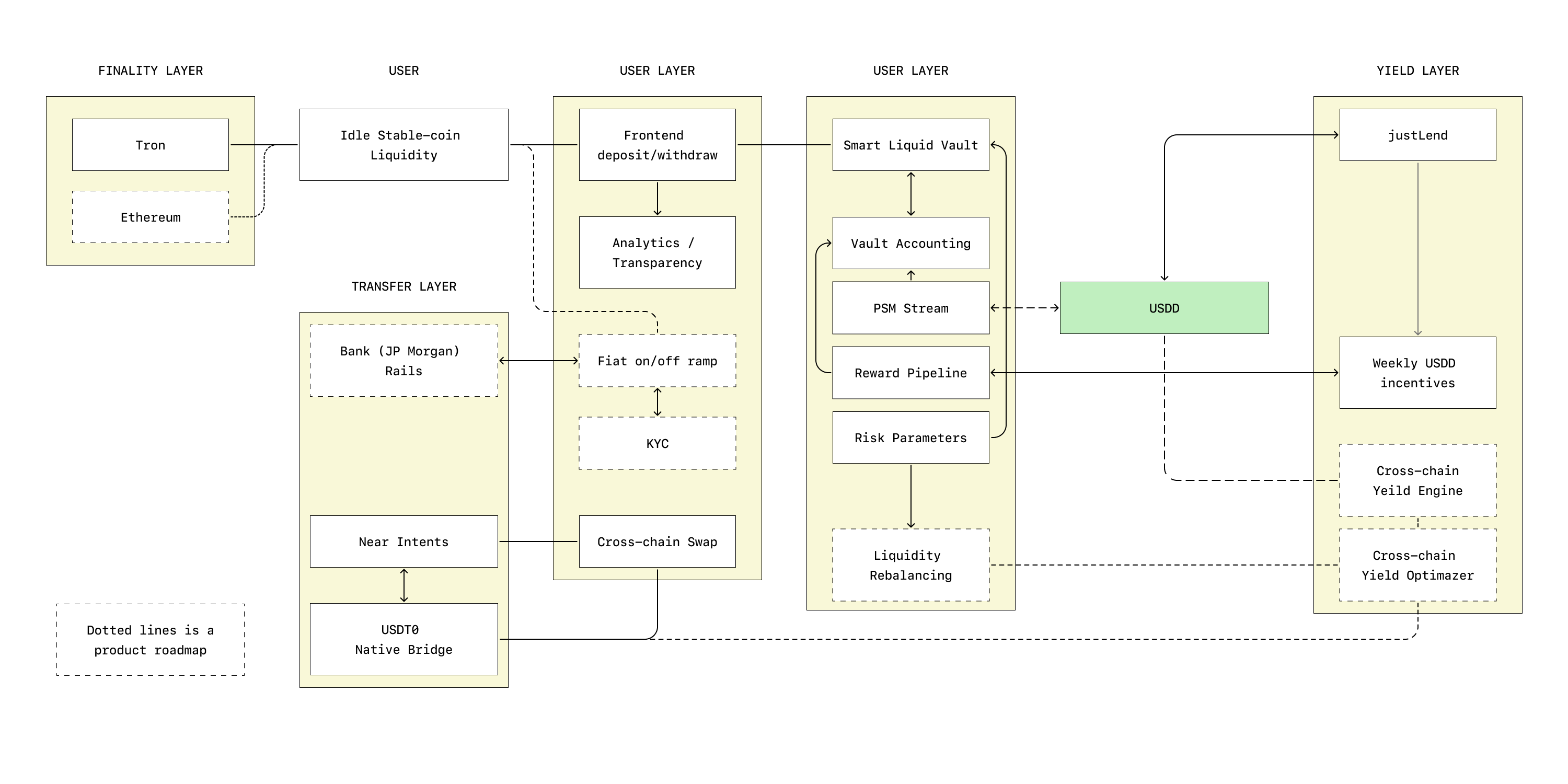
System Layers
The L2Pass Overnight Yield architecture is organized into five functional layers to separate execution, liquidity movement, and yield generation.1. Consensys Layer
The underlying blockchain infrastructure providing finality and settlement for all protocol interactions.- TRON: The primary execution environment for the current vault implementation.
- Ethereum: Planned for future expansion to support multi-chain yield strategies.
2. Transfer Layer
Manages the conversion and movement of assets between stablecoin variants.- Native USDT (TRC20): The primary deposit and withdrawl asset for users.
- Peg Stability Module (PSM): Facilitates swaps between USDT and USDD.
3. User Layer
Interfaces for user interaction and position monitoring.- Vault Interface: Frontend for initiating deposit and withdrawal actions.
- SBT: Each staking position is represented by a Soulbound Token (SBT). Transfers are prohibited to ensure 1:1 mapping between the staking address and the yield position.
4. Smart Vault Layer
The core logic resides in the smart contract, which handles asset management and reward accounting.- Vault Accounting: Tracks balances in jUSDD units and manages user weights for reward distribution.
- Streaming Reward Pipeline: Manages the distribution of rewards over weekly epochs (604,800 seconds).
- Inactivity Protection: The protocol includes backfilling logic to ensure total weight is maintained even during periods without interaction.
5. Yield Layer
The destination for capital deployment to generate returns.- JustLend: Primary venue where USDD is supplied to mint interest-bearing jUSDD.
- Incentive Engines: Weekly distributions of USDT rewards funded by protocol managers or external partners.
Core Mechanics
Soulbound Position Tracking (SBT)
Upon the first deposit, the protocol mints a non-transferable ERC721 token (NFT) to the user’s address.- Minting: Triggered during the first active deposit.
- Burning: The token is burned if the user’s active deposit amount reaches zero.
- Transfer Restriction: Vault logic enforces that tokens can only be minted or burned, preventing secondary market transfers of yield positions as additional security layer.
Streaming Weight Accounting
The protocol uses a time-weighted mechanism to ensure equitable reward distribution:- Weight Calculation: User rewards are determined by
userWeightSeconds, representing the product of the active balance and the duration of the stake within a specific week. - Total Weight: A global
totalWeightSecondstracks the sum of all participant weights. - Accrual: Weights are updated (“accrued”) during every interaction (deposit, withdrawal, or claim). The protocol backfills missing weeks if no interactions occurred globally during a specific epoch.
Liquidity Routing Flow
- Deposit: USDT is transferred to the contract and swapped for USDD via the PSM. USDD is then supplied to JustLend to mint jUSDD.
- Standard Withdrawal: jUSDD is redeemed for USDD. USDD is then converted back to USDT via the PSM for delivery to the user.
- Direct Withdrawal: Users may redeem jUSDD for USDD and withdraw the raw USDD tokens directly. This path bypasses the PSM to mitigate potential liquidity constraints on the Price Stability Model.
Economics & Fees
Fees and Rewards
- Performance Fee: A protocol-level fee (curently 0%) is applied to rewards claimed via the Merkle distributor.
- **Rewards Distribution: **USDT rewards are added to the vault mapping and assigned proportionally based on accrued weight. Rewards should be claimed by each user independently.
External Dependencies
The protocol relies on the functional availability of the following external systems: TRON Network: For transaction finality. USDD PSM: For converting USDT into the yield-generating USDD token. JustLend: For the generation of lending interest via USDD staking.Learn more
User Flow
Detailed lifecycle of deposit and withdrawal actions.
Risks
Technical and economic risks associated with the architecture.