

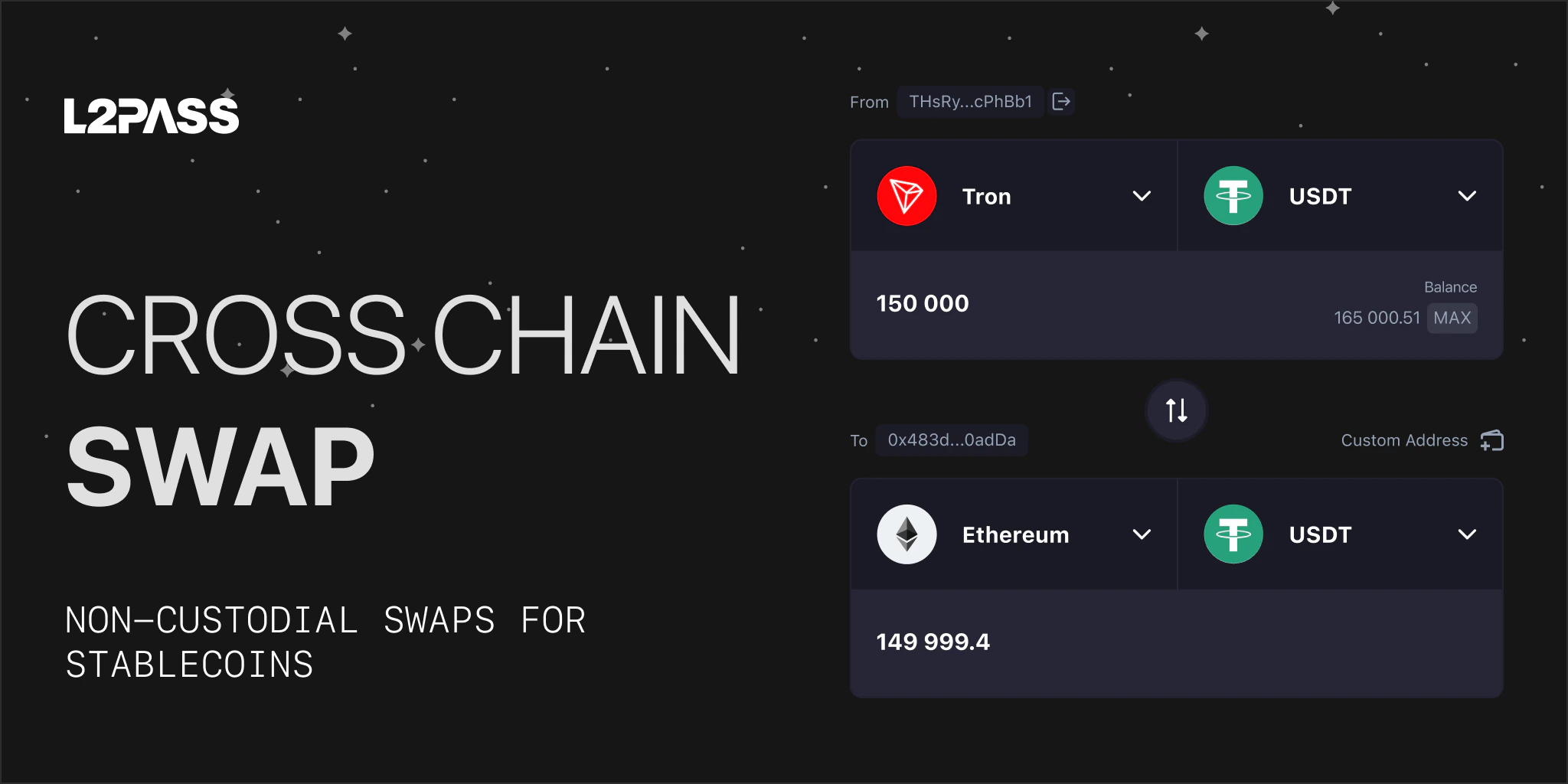
Supported Networks and Assets
L2Pass Swap currently supports Ethereum, Bitcoin, Zcash, Tron, Solana, TON, BNB Chain, Arbitrum, Base, Polygon, Optimism, Avalanche, Plasma and HyperEVM. Stablecoins (USDT, USDT0, USDC, DAI and others) are the main focus, but you can also swap major assets such as ETH, BTC, SOL, ZEC, TRX, BNB, AVAX and POL. Available tokens, networks and routes can change at any time; the swap interface always shows the current list.How Routing Works
When you request a quote, L2Pass asks several routing venues at once and shows every route that can fill your swap, sorted by what you will receive:- L2Pass RFQ by NEAR Intents: Request-for-quote routing through the NEAR Intents network, where solvers and market makers compete to fill your swap.
- L2Pass Private: The same solver network, executed in a confidential environment. See Private Swaps.
- USDT Native Bridge: Native USDT0 transfers over LayerZero, including from Tron.
- USDC Native Bridge: Circle CCTP V2 transfers of native USDC, in Standard and Fast modes.
- Aggregators and intent networks: LI.FI, LI.FI Intents, Relay, Aori and the OKX DEX aggregator.
How a Swap Is Executed
Depending on the route, a swap is executed in one of two ways:- Wallet transaction: You sign a transaction in your wallet and the route’s contracts execute the swap and bridge on-chain.
- Deposit address: For RFQ and Private routes, you send tokens to a one-time deposit address for your quote. You can send from your connected wallet, or transfer manually from any wallet or exchange using the address or QR code. If you send from an exchange, check that the amount that arrives matches the quote, since some exchanges deduct their withdrawal fee. The swap then moves through Awaiting deposit, Deposit confirmed and Complete, which you can follow in Recent swaps.
Execution Time
Settlement time depends on the route and the networks involved:- Fast routes (Relay, Aori, CCTP Fast) usually settle within seconds to about a minute.
- RFQ and Private routes typically take from about 30 seconds to a few minutes, longer for networks with slow block confirmation such as Bitcoin or Zcash.
- Bridge routes such as USDT0 typically take a few minutes.
- Slower routes such as CCTP Standard can take up to about 20 minutes while waiting for block finality.
Slippage and Price Impact
Price impact is the price shift caused by the trade size relative to the available liquidity. Comparing several venues helps keep it low. Slippage is the difference between the quoted price and the final execution price.- Slippage tolerance: The default tolerance is 0.05%. You can change it from any route card.
- Fixed output: Some routes, such as native USDT0 and USDC bridges, deliver a fixed amount, so slippage does not apply.
- Minimum received: Each route shows the Minimum Received amount, the worst-case outcome within your tolerance. If the price moves beyond it, the swap does not execute: on-chain routes revert, and deposit-address routes return your deposit to your refund address.
Fee Structure
The actual fees for your swap are always shown in the interface on the route card before you confirm. The estimated amount on the destination network already includes all fees.L2Pass Fee
Partner and Network Fees
Routing partners (bridges, solver networks, aggregators and liquidity providers) may charge their own fees. L2Pass does not control these fees; for the most up-to-date information, please check each provider’s documentation. Every blockchain transaction also requires a network (gas) fee paid in the native token, such as ETH, POL, BNB or TRX. Gas fees go to the network, not to L2Pass, and are not refundable.Private Swaps
Private swaps route your swap through a confidential execution environment instead of a public one, which limits what is visible on public blockchains. They are made possible by NEAR Intents, a third-party protocol.- Not anonymity: Your public wallet address is still included in requests sent to providers.
- Compliance still applies: Private swaps are subject to the same transaction screening and sanctions controls as other swaps.
- Fee: The L2Pass fee for a private swap is up to 0.3% (instead of 0% or 0.2%, not in addition). Like every fee, it is already included in the amount shown in the quote.
Execution Guarantees
- No partial fills: L2Pass does not use partial execution. A swap either completes in full or does not execute.
- Refunds: If a swap cannot be completed, for example because the price moved beyond your tolerance or the quote expired, your deposit is returned to your refund address. Provider and network fees may be deducted from the refunded amount.
- Compliance reviews: If a provider flags a swap as high risk under its AML or sanctions rules, the provider decides whether to complete, refund or hold it, and a refund is not guaranteed. L2Pass cannot override a provider’s review.
Swap FAQ
Answers to common questions about L2Pass Swap, including fees, routes, refunds and supported networks.